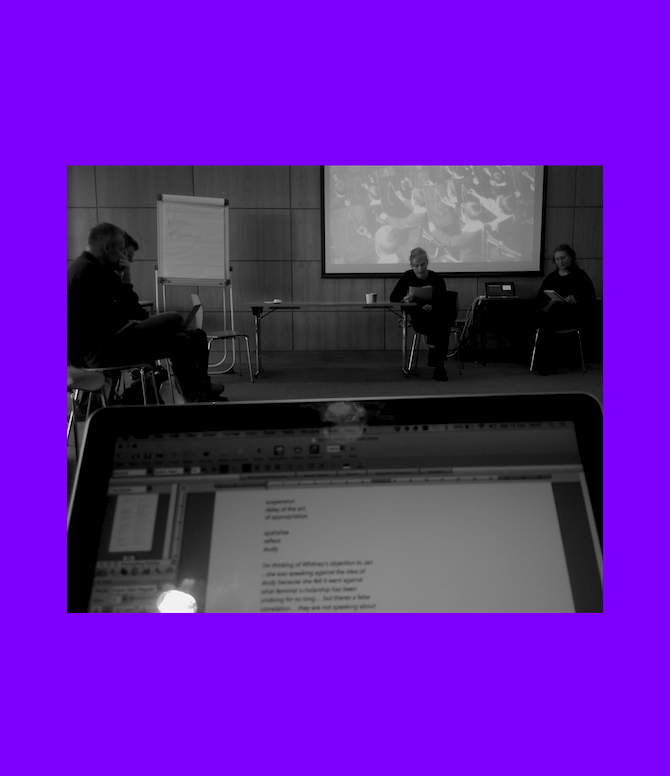
All the way back in 2017, I was involved in a research colloquium about the ethics of code (software) and the use of algorithms, particularly in relation to education and learning. Those of us present were asked to bring a question to pose to and discuss with our fellow participants.
I assembled an audio collage of YouTube videos related to my search for documentaries and/or discussions of ‘algorithms’. The question of the algorithm — what it is, what it does, who makes it, for what purpose and in whose interests — is a recurring one for me. When I think of algorithms, I think of movement, of power, of relationship, of choreography. Digital, software based algorithms are perhaps a kind of metaphor for a basic human need for attention and attachment. I find the fields of Critical Data Studies pretty abstract and challenging to understand. I find the worlds of data, computers, coding, soft/hardware engineering unnervingly meaningless. What I mean is, I find it hard to find or feel meaning in these worlds. And so, I’ve made it a sort of ridiculous mission to make meaning in/of these technological worlds.
In an effort to rustle up a question for this colloquium, I’ve assembled some roughly recorded audio for us to listen to. I did this yesterday, from my sitting room. I used my laptop and the YouTube search engine. I recorded the sounds ambiently using my zoom H2 recorder. At the end of assembling this audio collage, I think I am asking:
What kind of pedagogies do we need to develop to understand (a) what an algorithm is used for and what it can do in the world and (b) how the concept of the algorithm is discussed in public arena’s and how this effects how we think and conceptualise our own agency in a ‘datafied’ society?
The clips are as follows:
1. I play an album by Irish musician Ailbhe Ní Oireachtaigh. She plays improvised viola with a tape feedback loop. It’s full of tension. It takes over the whole house. I decide to pace through my house in time with the music and make a recording. I use this to begin the audio collage you’re about to listen to. https://fortevilfruit.bandcamp.com/album/oreing
2. I listen to an interview on The Open Mind webchannel with mathematician Cathy O’Neil, played through YouTube. She wants to tell people about how mathematics, algorithms, are being deployed by State apparatuses in the USA. She is concerned that people do not feel they have the right to question mathematics… they have no way to defend themselves agains ‘weapons of math desctruction’. https://www.youtube.com/watch?v=cK87rN4xpqA
3. I search for a particular episode of BBC’s In Our Time programme, hosted by Melvin Bragg. The topic is Maths in the Early Islamic World. There is a moment where Bragg gets frustrated by one of his guests, because he is not explaining the concepts clearly enough. Bragg is questioning the Professor of Physics Jim Al-khalili on behalf of his audience.
4. On the same show, Reader of Pure Mathematics, Colva Roney-Dougal is challenged by Bragg to explain what an algorithm is. http://www.bbc.co.uk/programmes/b08dr5qt
5. I find a video through YouTube based on a search for Algorithm documentaries – I come across a talk by Prof. Safiya Noble, an expert in Communication and Information Studies. I skim through and record random snippets from her talk. https://www.youtube.com/watch?v=iRVZozEEWlE&ab_channel=PdFYouTube
6. I return to Cathy O’Neil’s interview on The Open Mind. She talks about how algorithms are being deployed unfairly to assess and judge people as if they are fixed entities: such as criminals or teachers.
7. I search, using YouTube, for Prof. Luciano Floridi – remembering that his work relates to the philosophy of information – I find a short interview and I record some snippets of what he says.
8. In my YouTube search for Algorithm Documentaries, I come across a documentary called Algorithms. It’s about Blind Chess Players in Indian. I use some of the music to end the audio collage you’re about to listen to. http://www.imdb.com/title/tt2616594/
 Jessica Foley